
For CAs
What your client's Ordence hands their CA.
For the chartered accountant (CA) of a business on Ordence: Tally-ready vouchers, the GSTR-1 file, a 2B match and a log of every change, all from the records the business sells from. You keep Tally, the filing and the client.
What you receive
Seven things, all from the business's own entries.
- Tally-ready XML. Vouchers you import into Tally. No retyping.
- GST data. GSTR-1 JSON, GSTR-3B figures, and GSTR-2B matched to purchase bills, with the IMS (invoice management system) decision kept per row.
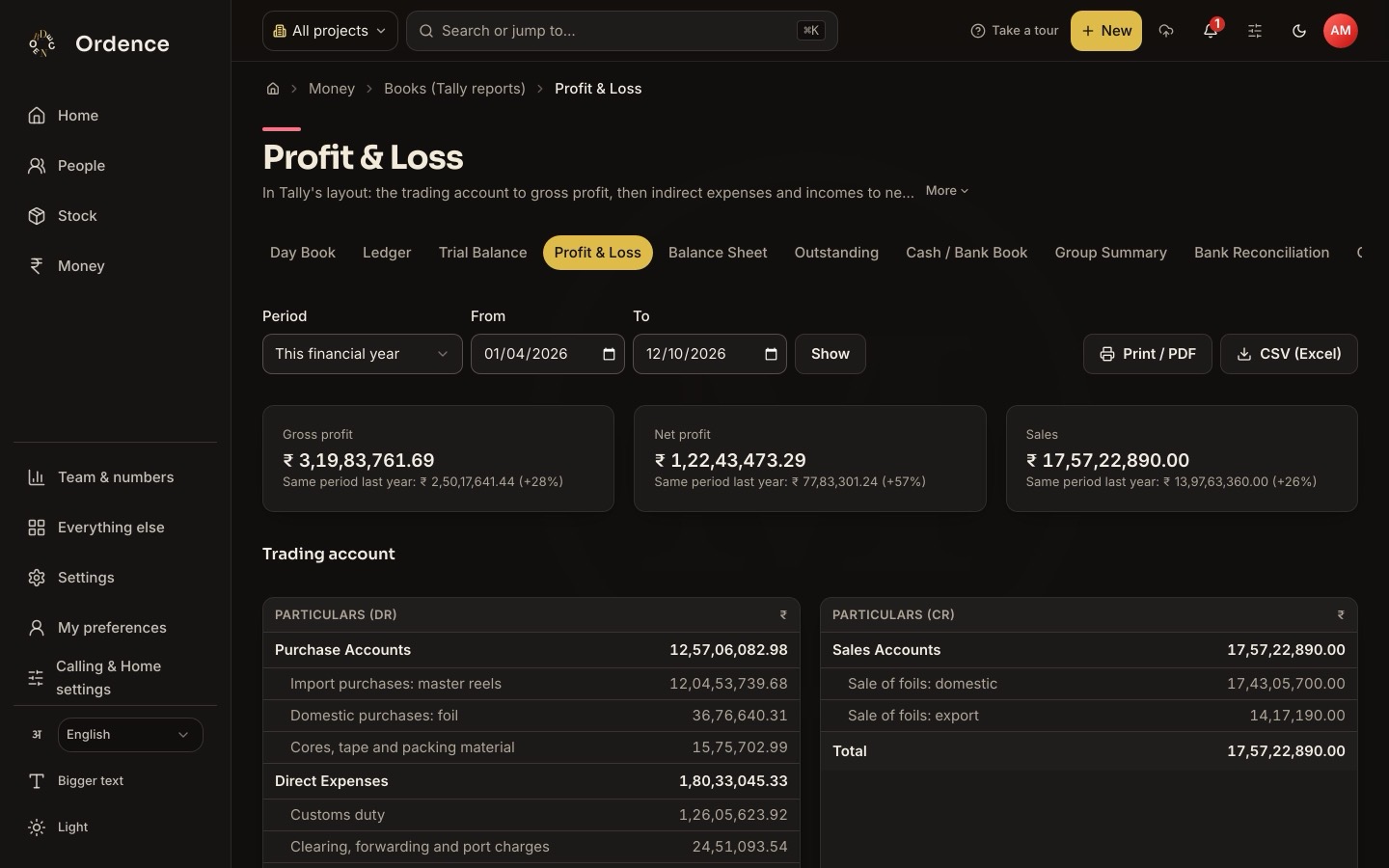
- The books. Double-entry ledger, day book, trial balance, P&L, balance sheet and bill-wise ageing.
- Bank reconciliation. HDFC, ICICI, SBI, Axis and Kotak statement formats, receipts matched to invoices. Nothing posts until a person confirms.
- TDS tracking. Section and rate per deduction, including the 206AA rate when a party has no PAN.
- The MSME clock. MSME status per vendor, and the 43B(h) 15- or 45-day clock on bills from micro and small manufacturers and service providers. Traders are outside it.
- A trail. A voucher edit log that cannot be edited, a period lock, and an audit log of changes, approvals and exports.

Your access
Your own login, opened as far as the work needs.
8 roles and 118 permissions, with per-user overrides, so you and your client decide what you see. Sign-in supports passkeys and authenticator 2FA.
What you stop doing
Year-end work no client pays for.
- Retyping sales invoices. They arrive as vouchers in Tally-ready XML.
- Chasing a stock list that does not balance. The upload is refused until it does.
- Working out who changed a voucher. The log names the user and the change.
- Ticking a bank statement by hand. Receipts arrive matched, for a person to confirm.
How it sits with Tally
Vouchers both ways, by connector or by file.
Ordence imports TallyPrime or Tally.ERP 9 data, reconciles against it and exports Tally-ready XML. An optional connector on the Tally PC moves vouchers both ways. It never creates ledgers or deletes anything in Tally.
- Imports are XML or CSV, for more than one company.
- If a voucher names a ledger Tally lacks, the connector refuses and names it. Every Tally ledger stays one you made.
- E-way bill files are prepared for upload. Invoices carry what e-invoicing needs; the IRN and e-way bill number come from the portals and are recorded on the invoice.
Questions
What CAs ask first.
Does Ordence replace Tally?
No. Tally stays. Data moves both ways, by file or the optional connector.
Does it file GST returns or e-invoices?
No. It prepares GSTR-1, GSTR-3B and e-way bill data, and records the IRN from the IRP; you or your client file on the portal. Nothing is filed by API.
Does it handle TDS returns and payroll?
No. It tracks TDS by section and rate, including 206AA, but does not file TDS returns or run payroll.
Can I see who changed a voucher?
Yes. Edits go into a log that cannot be edited, and a period lock stops back-dated changes.
Nominate the client whose year end costs you most.
Send the business name and the reconciliation that eats your March. A founder reads every nomination and replies in writing.
Questions first? Email the founders.