
Pharma distribution
Built, no customer yet
The right batch on the bill, under the ceiling, with the scheme on the line.
For stockists who buy at PTS (price to stockist) from the principal (the drug company) or its C&F agent, and sell at PTR (price to retailer) to chemists on schemes. Each line carries batch, expiry, the agreed free quantity, and a price checked against the NPPA (the government price regulator) ceiling. Works next to Tally.
Where this stands
Built, no customer yet. No stockist or distributor runs this pack. Ordence runs at eight businesses (five on an industry pack and three on the core system); none is in pharma. If you want software proven in your trade, a product many distributors already run is safer. If you would rather be first, it is set up for your principals, schemes and licences before any billing.
The business, desk by desk
From the principal's invoice to the chemist's next order.
Purchase and inward
Stock received by batch and expiry. Supplier bills matched to GSTR-2B; missing ones flagged.
QC hold and release
A batch on quality hold cannot be billed until released. For makers, a named person must sign the release.
Godown and picking
Each batch counted with its expiry, and picked FEFO: first expiry, first out.
Billing
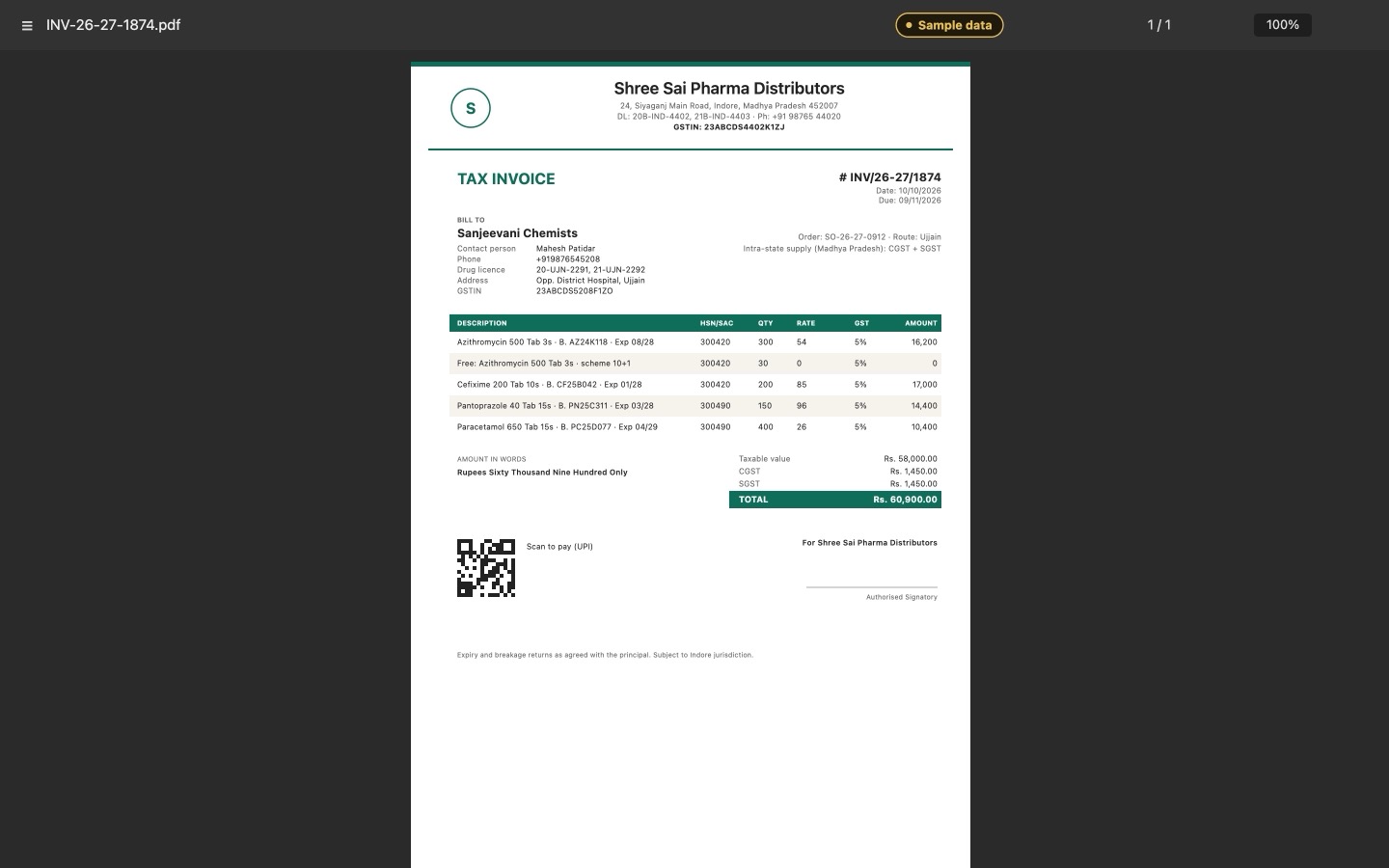
Free quantity (like 10+1) and value slabs on the line. Batch, expiry and HSN on every line, at the GST rate of the invoice date. The pre-tax price is checked against that day's NPPA ceiling; a line above it is refused.
Registers
Schedule H1 and Schedule X entries are written with the bill and never edited. No H1 or X drug leaves without one.
Field sales
Secondary sales by beat (the rep's round) and by outlet. Chemists late for their usual order are listed before the next beat.
Returns and claims
Saleable, breakage and expiry returns are kept apart. Near-expiry stock sent back as saleable is refused and becomes an expiry claim. Each claim shows sent, credited, and the gap still to recover.
Licences
Drug licences (Form 20B and 21B) flagged ninety days before they lapse.
What a stockist gets first
What distributors ask about first.
- FEFO picking. Oldest expiry leaves first.
- Free quantity on the line. Taxed with the sale. Doctor's samples go on a separate document.
- The NPPA ceiling. Checked on the day of supply, at billing.
- Schedule H1 and X registers. Locked once written.
- Expiry claims in three figures. For every claim on every principal.
- Statements chemists fetch themselves. Bills and statements from a portal.
What it means: a held batch cannot go out by mistake, and the 10+1 agreed with a chemist is on that chemist's bill.

GST for pharma distribution
A stockist's GST duties, and what Ordence does.
What GST asks of you
Medicines under HSN 3003 and 3004 are 5% since 22 September 2025. 37 listed drugs are nil-rated. The rate on APIs (bulk drugs, Chapter 29) is a question for your CA.
Free samples are not a supply, and input tax credit on them is blocked (Circular 92/2019).
A “buy one get one” offer is one sale of two goods, so credit stays (Circular 92/2019).
Expired goods go back either on a fresh tax invoice, or on a credit note with the goods on a delivery challan (Circular 72/2018). The credit note cuts tax only if issued by 30 November after the year of supply.
Stock destroyed after expiry or breakage loses its input tax credit, which must be reversed (Section 17(5)(h)).
Sell nil-rated drugs too, and credit used for both, such as rent, is split under Rule 42.
Above ₹5 crore turnover: an IRN on every invoice and credit note to a registered buyer, and 6-digit HSN codes.
Job work on medicines is 5% since 22 September 2025.
What Ordence does
Each HSN's rate kept with its start date, so past bills stay right.
Batch, expiry and HSN on every line.
Free quantity taxed with the sale. Physician samples on their own document, with the credit to reverse worked out and posted to the books.
Each destruction of expired or broken stock records, batch by batch, the credit to reverse, posted to the books.
Input tax credit is checked line by line on every purchase bill, by HSN and date, with blocked credits under section 17(5) flagged and kept out of your claim.
Common credit split under Rule 42, from the exempt sales you enter.
E-way bill data prepared from the invoice. The IRN is made on the portal and recorded against it.
Breakage and expiry returns kept apart; each claim checked against what came back.
GSTR-1 and GSTR-3B figures ready, GSTR-2B matched, for your CA to file.
GST rules last reviewed 16 October 2026, against CBIC notifications and GSTN advisories. Rates and limits change. Confirm how they apply to you with your CA.
In every Ordence system as well
Three shared parts. The full list is on the industries page.
- Dues by chemist. Reminders on the due date, in Hindi if the chemist prefers.
- A role for the billing clerk. Each desk gets its own role, from eight. All changes are logged.
- Agents that draft. Before the beat, an agent drafts the list of late chemists for the rep to check.
What it does not do
- It is not built for a chemist's retail counter. Ordence has no point-of-sale screen.
- Returns and e-way bills: prepared here, filed by you or your CA. The IRN from the IRP is recorded on the invoice.
- Ordence does not create or delete Tally ledgers. Entries reach Tally by file or the optional connector.
- It holds no security certification today.
Questions
What stockists ask first.
Can a batch on hold be billed by mistake?
No. It stays unbillable until released, and a maker's batch needs a named person's signed release.
What happens to a line priced above the NPPA ceiling?
It is refused. It cannot go on the invoice.
How are free quantity and physician samples handled for GST?
Free quantity (the 1 in 10+1) is taxed with the sale. Doctor's samples get their own document, with the credit to reverse worked out and posted to the books.
We bill at a chemist counter. Is Ordence for us?
Probably not. There is no point-of-sale screen. The pack is for stockists, distributors and the makers who supply them.
Is any pharma business running Ordence today?
Not yet. You would be the first.
Bring a batch-wise stock statement.
Mark near-expiry lines and add last quarter's claims. We show how Ordence would hold that stock, and say so if it does not fit.
Questions first? Email the founders.