
Real estate developers
In use at a developer for enquiries, site visits and follow-ups
One tower, read the same way by sales, site and accounts.
For developers who sell flats in a tower, build through contractors, and collect as construction stages finish. Units sold, demands raised, contractors billed and 70% kept in the RERA designated account, all from one record. Works next to Tally.
Where this stands
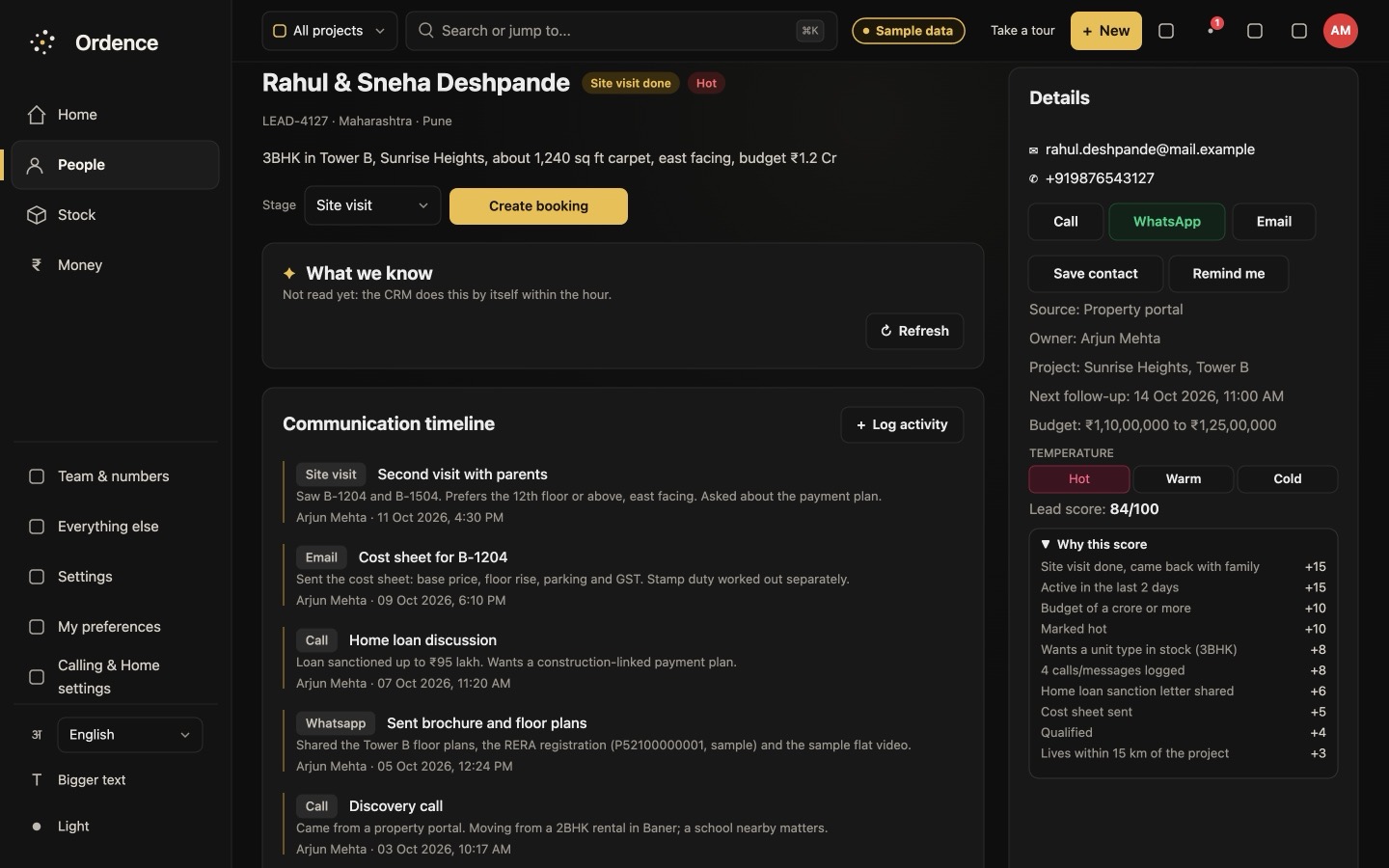
In use at a developer for enquiries, site visits and follow-ups. That is its sales desk. Bookings, stage demands, contractor RA bills (running bills) and the RERA account are built; no developer runs them yet. The first would have projects, towers and payment plans set up before any demand letter goes out.
The project, desk by desk
From land file to possession, one project at a time.
Land and approvals
Land and title records, and a diary of pending approvals, per project.
Sales
Enquiries tagged by source: Meta ads, property portals, walk-ins, channel partners (brokers) and the NRI desk. Each is scored on source, site visit and budget; every visit gets a follow-up on its date.
Inventory and pricing
Projects, towers, units and plots, each marked available, booked or handed over. Floor rise, view and corner premiums set per unit, with a cost sheet and stamp duty for each.
Bookings
Booking, unit, tower and project in one line. A cancellation is its own entry, and its GST is reversed by credit note while the section 34 deadline allows.
Engineering and contracts
Drawings, BOQ (bill of quantities), variations, works contracts and RA bills. Contractor bills and materials tracked against budget.
Collections
Once a stage is measured on site, a demand letter goes out under the agreement for sale, with GST and the buyer's 1% TDS worked in. Late instalments get reminders and interest.
The RERA account
Every receipt is split so 70% sits in the project's own designated account. A withdrawal needs all three certificates: architect, engineer and CA.
Possession and society handover
Possession recorded per unit, with revenue booked then. The society handover clock starts at the occupancy certificate.
What a developer gets first
What developers ask about first.
- Units by status. One view of what is free, booked or handed over.
- Site visits that get a call back. From enquiry to booking, with each broker's commission owed.
- Demand letters on the stage. Payments set against each one.
- Interest a buyer can check. The notice shows the basis and every period, so a dispute comes with its working.
- Channel partners see their own brokerage. On their own portal, where they also register enquiries. Buyers see their own account.
What it means: a buyer who says the slab is not cast gets one answer from sales, site and accounts, because all three read the same record.

GST for real estate developers
A project's GST duties, and what Ordence does.
What GST asks of you
Residential flats in projects begun from 1 April 2019: 1% for affordable housing, 5% for the rest, without input tax credit.
Affordable means carpet area up to 60 m² in a metro or 90 m² elsewhere, and a price up to ₹45 lakh.
At least 80% of inputs and input services must come from registered suppliers. Any shortfall is taxed at 18% under reverse charge, project by project, each year.
Cement bought from an unregistered supplier is under reverse charge at 18%, since cement moved to 18% on 22 September 2025.
No GST on a unit when the whole price is received after the completion certificate, or first occupation if earlier.
Commercial units: 5% without input tax credit in a residential project (commercial area up to 15%), otherwise an effective 12% with credit. These rates already allow for land as a one-third deduction, and none changed on 22 September 2025.
Tax at 1% or 5% is paid in cash. Development rights (TDR, FSI) bought from a landowner, including under a joint development agreement, are under reverse charge on the developer, exempt for residential units sold before completion. Flats given to the landowner in exchange are taxed at 1% or 5%.
What Ordence does
GST on each stage demand, at the project's rate.
Place of supply is where the property stands.
GST reversed by credit note when a booking is cancelled, up to the section 34 deadline (30 November after the year of the invoice). After that, the tax that can no longer be reversed is worked out separately.
Input tax credit on contractor and supplier bills is checked line by line, by HSN/SAC and date, with blocked credits under section 17(5) flagged and kept out of your claim. Bills are matched to GSTR-2B. On a 1% or 5% residential project there is no credit to take.
The buyer's 1% income-tax TDS credited on each receipt.
Not yet in the system: the 80% registered-supplier test, reverse charge on cement and on development rights, and the one-third land deduction on the invoice (GST is charged at the effective rate on the full amount). Your CA works these out.
GST rules last checked 16 October 2026, against CBIC notifications and GSTN advisories. Rates and limits change. Confirm how they apply to you with your CA.
In every Ordence system as well
Three shared parts. The full list is on the industries page.
- Reminders in the buyer's language. Instalment reminders on the due date, in Hindi if preferred.
- A role for each desk. Sales, CRM, site and accounts each get one of eight roles. Every change is logged.
- Agents that draft. An agent drafts Monday's call-back list after weekend site visits. Sales decides who gets called.
What it does not do
- It does not file GST returns or anything with a RERA authority. It keeps the records they are made from, for you, your CA and your professionals.
- It does not yet work out the 80% registered-supplier test, or reverse charge on cement and development rights.
- Tally ledgers are never created or deleted from Ordence. Entries go across by file or the optional connector.
- It holds no security certification today.
Questions
What developers ask first.
Does Ordence keep the RERA designated account separate?
Yes. 70% of every receipt goes to the project's own account, and a withdrawal needs all three certificates.
How is GST calculated on a stage demand?
At the project's rate, with place of supply where the property stands. A cancelled booking reverses it by credit note, up to the section 34 deadline.
Can channel partners see their own enquiries and brokerage?
Yes, on their own portal. Buyers see their own account too.
How is interest on a late instalment shown?
Each notice states its basis and lists every period with opening balance, days and interest, so the buyer can check it line by line.
Does it check the 80% registered-supplier rule?
Not yet, nor reverse charge on cement or development rights. Your CA works these out.
Is any developer running the real estate pack today?
One developer uses it for enquiries, site visits and follow-ups. For bookings, demands, RA bills and the RERA account, you would be the first. Ordence runs at eight businesses: five on an industry pack, three on the core system.
Bring one tower's demand register.
With each demand's stage and what came in against it. We show the same tower in Ordence, and say so if it does not fit.
Questions first? Email the founders.