
Jewellery and diamonds
In use at a jewellery business for catalogue, orders and dealers
Rate of the day, fine weight, and every gram with a karigar.
For jewellers, bullion dealers and diamond traders. At closing, know the grams in the safe, the grams with karigars (the craftsmen who make the pieces), and which tagged pieces sold. Bars and loose diamonds share one stock. Works next to Tally.
Where this stands
In use at a jewellery business for catalogue, orders and dealers. That is its sales side. The rate of the day, karigar metal, HUID and old gold exchange are built; no jeweller runs them yet. The first would have rates, purities, making charges and karigars set up before pricing a piece.
The business, from the safe to the karigar and back
The rate, the pure-gold weight, every piece.
The rate desk
A rate per purity, such as 22K (916) and 18K (750), set each morning and reset when the market moves. Each estimate and invoice keeps the rate it was priced at.
The safe and stock
Gross, net and fine weight (pure metal) on every piece and bar, worked out from net weight and purity (the touch) to the milligram. Loose stones too, with lots and branch transfers.
Karigars
Fine grams given to each karigar, pieces back, and the balance still out, against the wastage agreed with them.
Hallmarking
HUID (the six-digit alphanumeric hallmark ID) and purity on every tag. A piece that must be hallmarked cannot be billed without it.
Estimates and tax invoices
The estimate is the quote; the tax invoice is the sale. Rate, fine weight, making charges and stones on separate lines, GST on the total. Making charges per gram, per piece or as a %.
Old gold exchange
Bought in at tested purity and set off after GST on the new piece.
Wholesale accounts
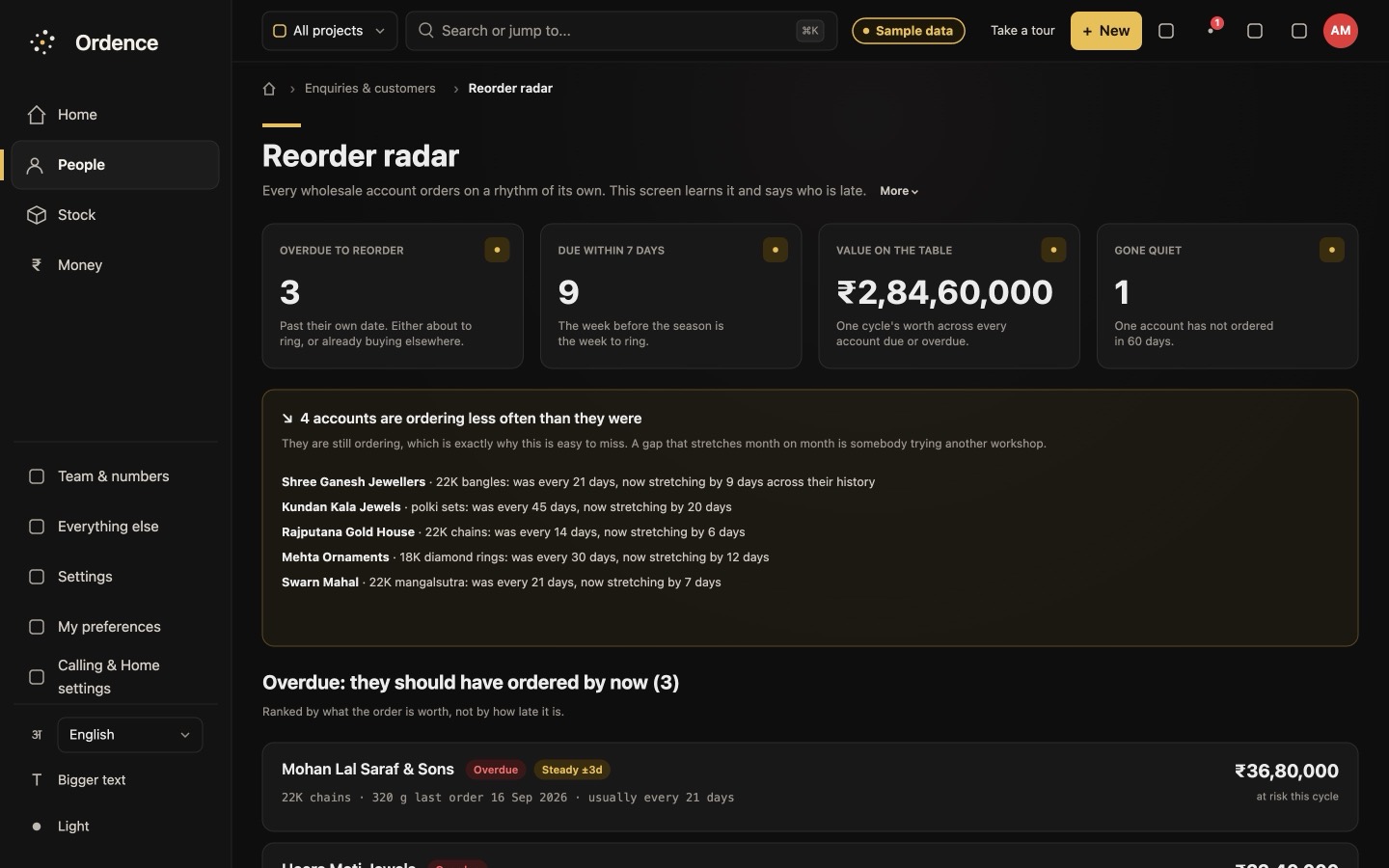
Accounts late for their usual order are listed for a call. Deliveries signed on a phone, even offline. Each account has a portal with its bills and balance.
What a jeweller gets first
What jewellers ask about first.
- One rate per purity, per moment. Frozen on every bill.
- Fine weight on every piece. Worked out by the system, never by hand.
- The karigar balance in fine grams. Always current.
- No HUID, no bill. Where hallmarking is mandatory.
- Old gold after the tax. So the new piece is taxed on its full value.
What it means: no gram goes missing between the safe, the karigar and the counter.

Diamonds and stones
Loose diamonds and stones sit in stock beside the metal. Their value joins the one figure GST is worked on: metal at the day's rate, making charges and stones, then tax. Diamonds have their own GST rates, below; the diamond job-work rate is set with your CA at setup.
Some diamond-trade work is not built. Approval memos, the jangad (goods sent on approval; ownership passes only at the bill), are planned. Rap-discount pricing, an IGI or GIA certificate register per solitaire, and a cutting unit's rough-to-polished process are not claimed. If that is your business, say how you work when you apply and we will say if it fits.
GST for jewellery and diamonds
A jeweller's GST duties, and what Ordence does.
What GST asks of you
Gold, silver and jewellery are 3%. The September 2025 rate changes left this alone.
Cut and polished diamonds are 1.5%. Rough diamonds are 0.25%. Lab-grown diamonds follow the same split; coloured stones, natural or synthetic, are 0.25% whether cut or not.
Making charges on your own bill are part of the 3% sale, not a separate 5% line. Karigar job work on your gold is 5%; job work on diamonds is 1.5%. Both are input tax credit once the karigar's bill is in your GSTR-2B.
Old jewellery bought from a private person carries no reverse charge. It does not cut the GST on the new piece: tax the full value, then deduct it.
No e-way bill for precious metals, stones and jewellery, except for movement within Kerala.
A wholesaler whose turnover passed ₹5 crore in any year since 2017-18 must e-invoice every B2B bill. Counter sales to consumers are outside it.
What Ordence does
Metal at the day's rate, making charges and stones as one value, GST on the whole.
Old gold settled after the tax, as a purchase at tested purity.
Gold to and from each karigar, by fine weight. An issue can carry its job-work challan, and ITC-04 figures are prepared from challans.
Diamond and karigar job-work rates set with your CA at setup.
Input credit checked line by line on every purchase bill, by HSN and date, and held back until the bill shows in GSTR-2B. Old gold is settled after the tax, never netted against it. Nothing is filed for you.
GST rules last reviewed 16 October 2026, against CBIC notifications and GSTN advisories. Rates and limits change. Confirm how they apply to you with your CA.
In every Ordence system as well
Three shared parts. The full list is on the industries page.
- Dues by wholesale account. Reminders on the due date, in Hindi if preferred.
- A role for the counter and the safe. One of eight roles per desk. Every change is logged.
- Agents that draft. An agent drafts the list of late wholesale accounts. Nothing is sent or priced without a person.
What it does not do
- It has no point-of-sale screen. For a showroom counter alone, other products fit better.
- Gold savings schemes, approval memos (jangad) and a melting register are planned, not built.
- It does not file GST returns. It prepares the data; you or your CA file it.
- It holds no security certification today.
Questions
What jewellers ask first.
Does every bill keep the rate it was priced at?
Yes. Rates change through the day; each estimate and invoice keeps the one it was priced at.
How is metal with karigars tracked?
In fine grams: given, returned as pieces, and still out, against each karigar's agreed wastage.
How is old gold settled?
As a purchase at tested purity, set off after the tax. It does not reduce GST on the new piece.
Can a piece be billed without its HUID?
Not where hallmarking is mandatory. The billing screen refuses it.
Is the estimate the bill?
No. The estimate is a quote. The sale is a tax invoice, listing the HUID, with gold value and making charges on separate lines.
Is any jeweller running Ordence today?
One jewellery business, for catalogue, orders and dealers. For rates, karigar metal, HUID and old gold, you would be the first.
Bring last month's karigar register.
Issues, receipts and each karigar's allowed wastage. We show the same balances in fine grams, and say so if it does not fit.
Questions first? Email the founders.