
Distribution
Built, no customer yet
The load that should not leave stops at the dock.
For distributors and importers with stock in several warehouses, selling to dealers on credit and schemes. A load over the dealer's credit limit, or over ₹50,000 without its e-way bill number, does not pass the gate. Works next to Tally.
Where this stands
Built, no customer yet. This pack adds warehouses, dealers, schemes and credit to the roll and batch trading pack's stock, sales and GST. That shared core is live at a hot and cold stamping foil trader, and at two chemicals and trading businesses for price lists, credit limits and collections. No distributor runs it yet. The first would have warehouses, schemes and credit terms set up before any billing.
The business, desk by desk
One consignment, from port to dealer to bank.
Buying and imports
FOB (the supplier's price at their port), freight, duty and clearing spread over each unit. Import IGST stays out of cost and is held as credit.
Warehouse
Pallets go into labelled bins, scanned from any phone. A transfer between warehouses has its own document; stock on the way belongs to neither until it arrives.
The sales desk
A dealer late for their usual order is flagged for a call. Each order carries its scheme.
Picking
One walk, bin to bin, with batch and serial numbers recorded as you go.
Credit control
The dealer's limit and dues are checked at the dock, before loading out.
Dispatch
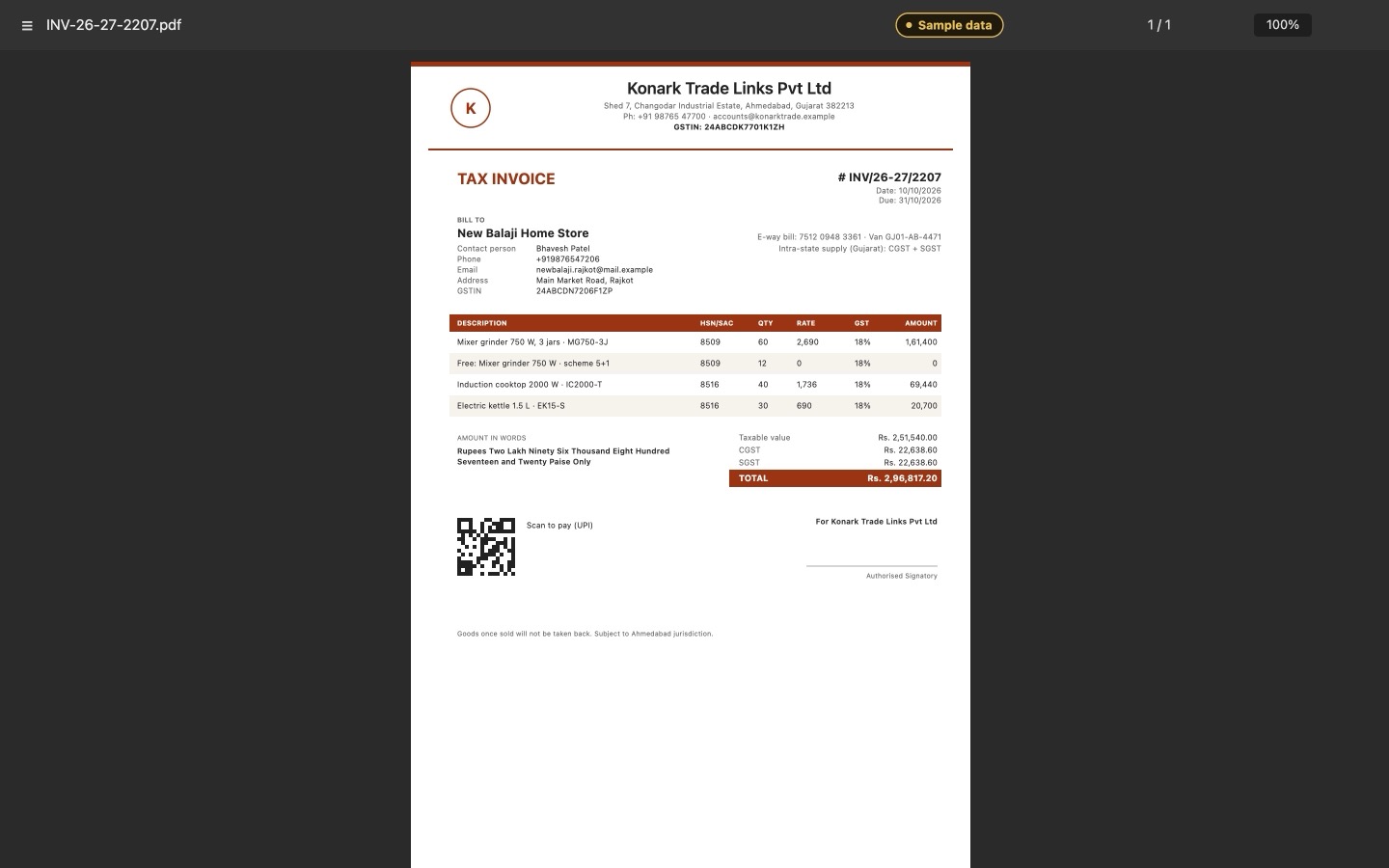
A consignment over ₹50,000 cannot leave the gate without its e-way bill number.
Van sales
A van is a warehouse on wheels. On return, stock short and cash short are shown apart, since each needs a different talk.
Schemes and claims
Each claim on the company (the brand you distribute) shows claimed, allowed and still due. It reaches the books when verified, not when raised.
Collections and accounts
Receipts matched to invoices, statements and reminders sent on the due date. Books exported for Tally.
What a distributor gets first
The five checks distributors ask about first.
- Landed cost per unit. The true cost of each unit, landed in your godown.
- A bin for every pallet. Found by scan in any warehouse.
- Picked in one walk. No back-and-forth in the aisles.
- Credit checked at the dock. Not after the truck has gone.
- Scheme claims you can argue from. Three figures per claim, ready for the company.
What it means: a bad load stops at the dock, not on the highway.

GST for distribution
What a distributor owes the law, and what Ordence handles.
What GST asks of you
A consignment over ₹50,000 moves with an e-way bill. Within one state, that state's own limit applies, often ₹1,00,000.
Turnover above ₹5 crore in any year since 2017-18 means e-invoices (IRN) on business sales and credit notes. At ₹10 crore or more, each must reach the IRP within 30 days.
Invoices show HSN: 4 digits up to ₹5 crore turnover, 6 beyond.
GSTR-3B tax is filled from GSTR-1 and locked. Corrections go through GSTR-1A or a later GSTR-1.
Import IGST from the bill of entry appears in IMS, from the October 2025 period, and flows into GSTR-2B.
A discount given after the sale cuts GST only if it was agreed before the sale, is linked to the invoices, and the dealer reverses the credit (Section 15(3)(b)). Otherwise it is a financial credit note, with no GST change.
The rate follows each item's HSN: 5% or 18% for almost all goods since 22 September 2025. The 12% and 28% slabs are gone.
Free units in a scheme, on the same invoice, are part of the sale: no credit is reversed (Circular 92/11/2019). Free samples, and stock lost or written off, lose their input credit (Section 17(5)(h)).
Moving stock to your own warehouse under another state's GSTIN is a supply, on a tax invoice with IGST.
Freight paid to a goods transport agency: 5% under reverse charge, unless the transporter charges 5% or 18% itself.
What Ordence does
HSN on every bill; CGST and SGST, or IGST, follow the place of supply.
Monthly GSTR-1 and GSTR-3B figures, built from your bills.
Your downloaded GSTR-2B matched against purchases; credit missing from it is held back and listed.
E-way bill files ready to upload, and the gate check above.
Import IGST counted as credit, never as cost.
Input tax credit is checked line by line on every purchase bill, by HSN and date, with blocked credits under section 17(5) flagged and kept out of your claim. Credit on stock written off, lost or given as samples is worked out batch by batch for reversal.
Each settled scheme claim records whether its credit note may reduce GST, invoice by invoice.
Ordence prepares the return data and e-way bill file; you or your CA file them on the portal.
GST rules last reviewed 16 October 2026, against CBIC notifications and GSTN advisories. Rates and limits change. Confirm how they apply to you with your CA.
In every Ordence system as well
Three shared parts. The full list is on the industries page.
- Dealer enquiries with an owner. Website, IndiaMART, JustDial and referrals, each assigned, with an alert after 60 minutes unanswered.
- Dues chased on the day. Reminders go when payment falls due, in Hindi if the dealer prefers.
- Agents that draft. An agent drafts a note to a dealer who skipped an order. Your team decides whether it goes.
What it does not do
- Filing stays with you: returns and e-way bills are prepared, never filed. The IRN from the IRP is recorded on the invoice.
- Tally keeps its own ledgers: Ordence never adds or deletes any. Entries go by file or the optional connector.
- It has no beat plan (a salesman's daily round of shops) today.
- It has no point-of-sale screen. For a shop counter, other products fit better.
- It holds no security certification today.
Questions
What distributors ask first.
Can a load leave without its e-way bill?
Not over ₹50,000. Such a load cannot leave the gate without the number. Ordence prepares the file; you or your CA generate the e-way bill on the portal.
Is landed cost calculated per unit?
Yes. Freight, duty and clearing are spread to each unit; import IGST is held as credit, not cost.
Is a dealer's credit checked before dispatch?
Yes, at the dock, before the load leaves.
How are scheme claims on the company tracked?
By three figures: claimed, allowed by the company, and still due. It is booked when verified, not when raised.
Is any distributor running Ordence today?
Not yet; you would be the first. Its shared core runs daily at a stamping foil trader, which sells by the roll, not to dealers.
Start with last month's outstanding and open claims.
Send dues by dealer and the claims still open with the company. We show where each figure would sit, and say so if the pack does not fit.
Questions first? Email the founders.