
Hospitals
Built, no hospital on it yet
Every implant lot on a patient’s bill, and every claim settled to the paisa.
The business side of a hospital: package bills, pharmacy and stores by batch and expiry, and TPA (third-party administrator) claims from pre-authorisation to settlement. Every issue lands on the visit's bill with its batch. No clinical records. Works next to Tally.
Where this stands
Built, no hospital on it yet. No hospital or nursing home runs this pack. Ordence runs at eight businesses (five on an industry pack and three on the core system); none is in healthcare. If you want software proven in your trade, a product many hospitals already run is safer. If you would rather be first, it is set up for your tariffs, packages, stores and insurers before any billing.
The money path
One admission, from the first estimate to the money in the bank.
- AdmissionThe visit opens with its payer and room category.
- EstimatePackage lines at ₹0, anything outside with its reason.
- Pre-authThe insurer's approved amount, and an enhancement if the stay grows.
- Issues by batch and lotPharmacy, stores and OT post to the visit, each with its batch.
- Final approvalThe bill closes and the insurer approves its share.
- DischargeRecorded as an event, after the final approval.
- SettlementWeeks later. Insurer, the patient's share and write-off sum to the bill.
- ReceivablesWhat each insurer still owes, oldest first.
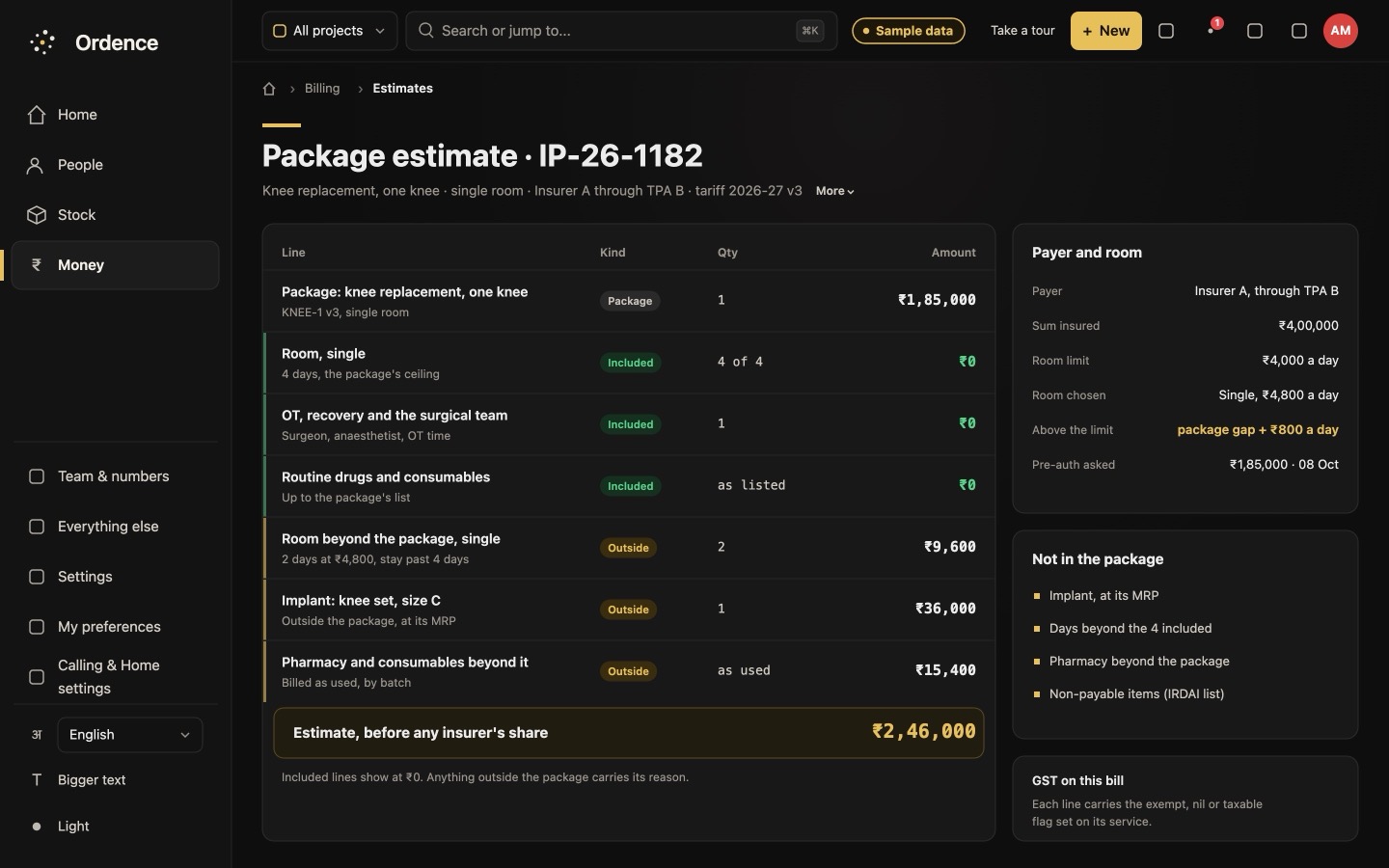
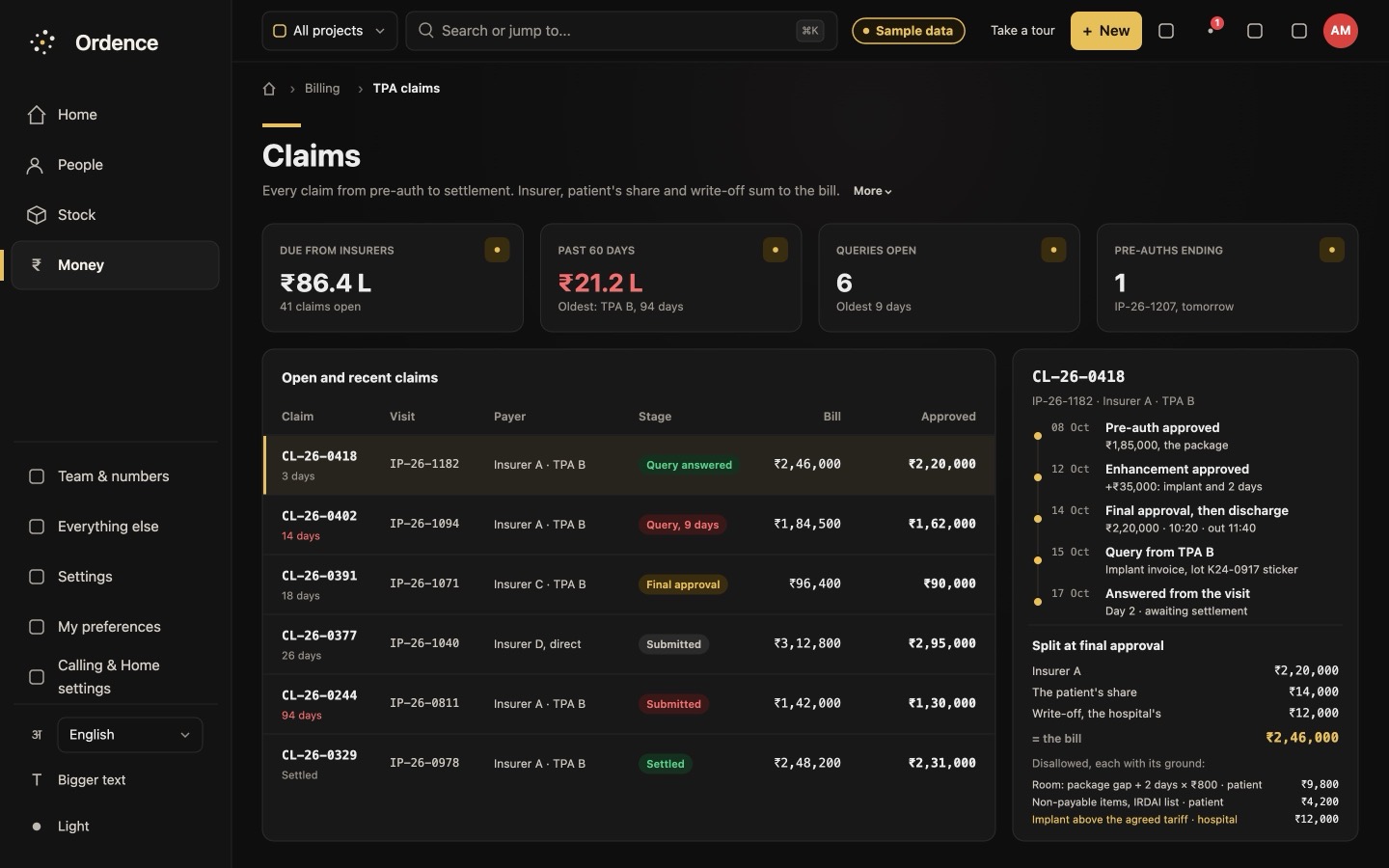
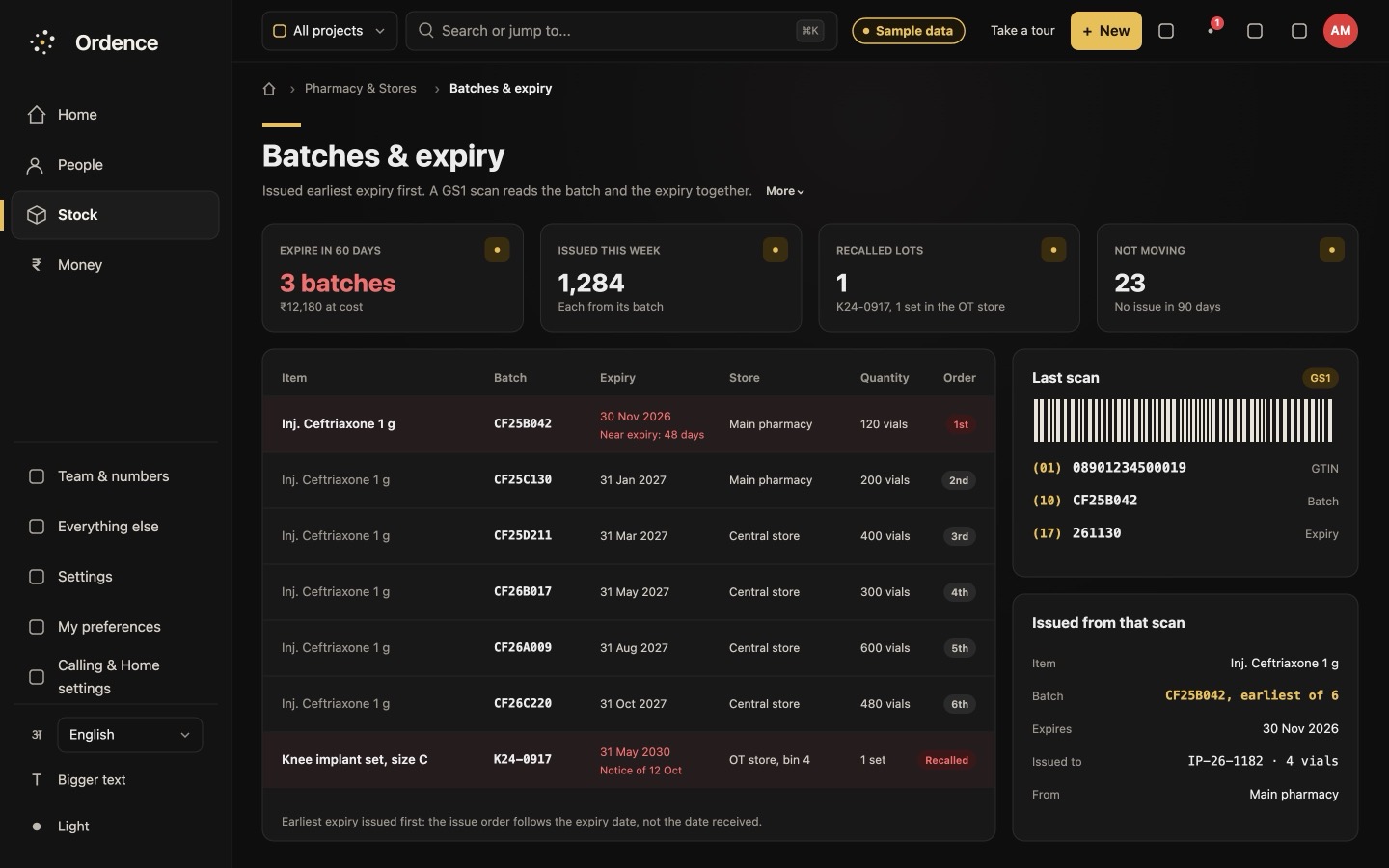
Sample data Visit IP-26-1182, admitted 08 Oct and discharged 14 Oct, billed ₹2,46,000: Insurer A ₹2,20,000, the patient's share ₹14,000 and a ₹12,000 write-off. The three screens below are this visit.
One visit, on three screens
Drawn with invented records, not taken from a hospital, since no hospital runs this yet.



The business side, desk by desk
From the estimate to the settled claim.
Enquiries
Website, referrals, corporate health check-ups and walk-ins, in one list. An unanswered one raises an alert.
Packages and estimates
A package estimate, line by line: room category, procedure and implants. What the package includes shows at zero; anything outside it carries its reason. Tariffs are versioned, and a bill keeps the tariff it was raised at.
Pharmacy and stores
Every batch with its expiry, issued earliest expiry first. A GS1 barcode gives batch and expiry in one scan.
OT issues
Consumables are issued to the case. A return reverses its issue, with the reason, so the bill carries only what was used.
Batch to bill
Issues post from stock with their batch. When a recall notice names an implant lot, that lot can be followed to each visit, and each bill, that used it.
TPA claims
Pre-auth, enhancement, final approval, settlement. The insurer, the patient's share and the write-off must add up to the bill, and each disallowed rupee carries its ground.
Discharge
Discharge follows the insurer's final approval and is recorded as an event. The insurer settles weeks later, against the bill as raised.
Claims and dues
What each insurer owes, oldest first, and what is due to suppliers.
Who uses it
Five desks, each with its own role. Clinical staff keep their own system.
Billing desk
Opens the visit, raises the package estimate from the tariff in force, and closes the bill. Every issue is already on it with its batch.
TPA desk
Pre-auth, enhancement, queries and final approval for each claim. A query is answered from papers already on the visit, and a short settlement shows each disallowed rupee and its ground.
Pharmacy
Issues by batch, earliest expiry first, to the visit or over the counter. A GS1 scan reads batch and expiry together.
Stores and OT
Consumables and implants issued to the case, with their lot. Unused items go back with a reason. What to buy, ranked by money.
Accounts
What each insurer owes, oldest first, and what is due to suppliers. Supplier bills matched to GSTR-2B. Entries to Tally.
What a hospital gets first
What a hospital's accounts and stores heads ask about first.
- Package bills that explain themselves. Inclusions at zero, extras with their reason.
- Earliest expiry issued first. Pharmacy and stores, by batch.
- Implant lots on the bill. A recalled lot followed to every visit that used it.
- Unused OT items returned. The return reverses the issue, so the bill stays right.
- Claims accounted for to the rupee. The insurer, the patient's share and the write-off sum to the bill.
- Stock planning. What to buy, ranked by money, and what is sitting still.
What it means: when a lot is recalled, the list of bills that carry it is already there, and a short settlement shows which rupees were disallowed and why.
What a month-end looks like
The close, desk by desk. Ordence prepares; your CA files.
Claims
Settlements recorded against each bill as raised. The patient's share and the write-off sit on the claim, each with its ground. What every insurer still owes, oldest first.
Pharmacy and stores
Batches close to expiry, so they are issued or returned in time. What to buy before next month, and what is sitting still.
GST
Supplier bills matched to GSTR-2B, missing ones flagged. You enter the month's exempt and total turnover, and the Rule 42 reversal is posted. GSTR-1 and GSTR-3B figures for taxable sales go to your CA.
Books
The month's entries reach Tally by file or the optional connector.
GST for hospitals
The GST the film shows, and what Ordence does.
What GST asks of you
Treatment is exempt, and so is what an admitted patient is billed as part of it: medicines, consumables, implants and prescribed food.
A room outside intensive care above ₹5,000 a day is taxed at 5%, with no input credit, since 18 July 2022. ICU, CCU, ICCU and NICU rooms stay exempt at any tariff. Walk-in and outpatient pharmacy sales are taxable, mostly at 5% since 22 September 2025; the 37 listed life-saving drugs are nil.
No input credit on what goes into exempt care. Credit common to care and taxable sales is reversed each month under Rule 42, and for equipment over 60 months under Rule 43.
Credit is claimed only on supplier bills that appear in GSTR-2B.
What Ordence does
Each bill line keeps its own GST treatment, so exempt care and taxable sales stay apart.
Input tax credit is checked line by line on every supplier bill, by HSN and date, with blocked credits under section 17(5) flagged and kept out of your claim. Credit common to care and taxable sales is split under Rule 42 and the reversal posted; you enter the period's exempt and total turnover.
Supplier bills matched to GSTR-2B; missing ones flagged.
GSTR-1 and GSTR-3B figures for taxable sales, ready for your CA to file. The exempt and nil rows are not filled in yet; your CA adds them.
GST rules last reviewed 16 October 2026: Notification 12/2017-CT(R) entry 74, 4/2022-CT(R) on room rent, Circular 32/06/2018 on in-patient supplies, Notifications 9/2025 and 10/2025-CT(R), and CGST Rules 42 and 43. Your HSN and SAC decide the rate; which of your lines are taxable is for your CA to confirm. Ordence prepares figures; it does not file.
In every Ordence system as well
Three shared parts. The full list is on the industries page.
- Reminders on WhatsApp, from one inbox. The hospital's number and each desk's own. A person reads each reminder before it goes.
- Statements suppliers and corporates fetch themselves. Each sees its own bills and balance on a portal.
- A role for each desk. Billing, pharmacy, stores and accounts each get their own role, from eight. All changes are logged.
What it does not do
- It holds no clinical record: no diagnosis, notes, orders or results. It is for the business side only.
- It makes no clinical decision and gives no clinical advice.
- Returns are prepared here and filed by you or your CA. The IRN from the IRP is recorded on the invoice; most hospital bills, being exempt or to patients, need none. Entries reach Tally by file or the optional connector.
- It holds no security certification today.
Questions
What hospitals ask first.
Does Ordence keep patient medical records?
No. It covers the business side only: estimates, bills, pharmacy and stores, claims and the books. Clinical records stay in the system you use for them.
Can a recalled implant lot be traced to patients' bills?
Yes. Issues post from stock with their batch, so the lot can be followed to each visit and each bill that carried it.
How are TPA claims handled?
Each claim moves through pre-auth, enhancement, final approval and settlement. The insurer, the patient's share and the write-off must add up to the bill, and every disallowed rupee carries its ground.
What happens to OT items that were issued but not used?
They are returned. The return reverses the issue, with its reason, and the bill carries only what was used.
Is GST charged on hospital rooms?
Only on a room outside intensive care above ₹5,000 a day: 5%, with no input credit. ICU rooms, and rooms at or below ₹5,000, are exempt.
Is any hospital running Ordence today?
Not yet. You would be the first.
Bring a package tariff and your open claims.
Add one month of pharmacy issues. We show how Ordence would hold them, and say so if it does not fit.
Questions first? Email the founders.